I knew James P. Doyle, Jim Doyle, as my professor at Fordham College in the Bronx, New York. This story comes from an arts advocate named Elizabeth Brouha, and it concerns Jim's post-Fordham life, when he lived in Sutton, Vermont, and taught at Lyndon State College. Jim was involved in an arts group that was funding a poet-printer's residencies in local schools, including the school that Jim and Ellen's son Joshua attended. One day Joshua came home, shouting "My poem is in the book. My poem is in the book." The book was a compilation of poems by children in the schools the poet-printer had visited. Ms. Brouha writes that Jim
was so tickled with the whole thing that he wrote a letter to Ellen Levell at the Vermont Council on the Arts about the whole experience. Ellen was going down to Washington, D.C. to plead that more money be given to National Endowment for the Arts so that the state councils could have more money for programs like these. She went before a committee and read them Joshua's poem and his father's letter. It was the greatest thing on the program. It carried the day and the Endowment did get more money.One of the mysteries of Jim's life is that he never — to the best of my knowledge, and I've checked, carefully — "published," as people in academia say. When Jim was getting ready to leave Fordham, he told me that he thought he was getting close to having something to say in print. But he left no critical writing aside from his dissertation (on the artist and type designer Eric Gill). So I was happy to find Jim's name in a book.
And that's the story of Joshua's howling success.
From an untitled essay by Elizabeth Brouha in Vermonters: Oral Histories from Down Country to the Northeast Kingdom ed. Ron Strickland (Hanover, NH: University Press of New England, 1998), 21

[From the book quoted above. Elizabeth Brouha sits in the center. That's Jim Doyle in the dark striped sweater.]
Other Jim Doyle posts
Department-store Shakespeare
Doyle and French
From the Doyle edition
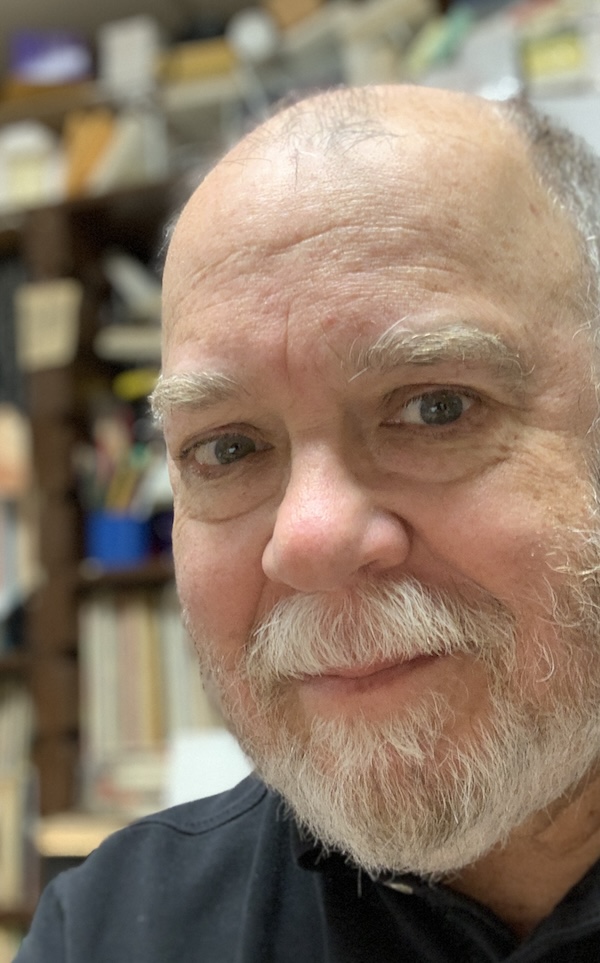
Jim Doyle (1944–2005)
Teaching, sitting, standing



comments: 6
Jim Doyle was my professor at Lyndon State College. Reading that you too adored him and miss him doesn't surprise me on bit. He was the heartbeat of my education. I miss him. Thanks for your postings.
M. Louise White
Devoted student of Doyle
He was one of a kind. Thanks for writing.
Thank you for posting your memories of Jim Doyle. For me, too. He was the college professor who touched and shaped my thinking and influenced my life more than any other. I was in his literature classes at Lyndon State CollegeinVermont from 1988-1992.
Christine Colwell
Thanks for sharing your thoughts here, Christine.
Is there a way to obtain access to Jim Doyle’s doctoral dissertation on Eric Gill’s work? Would it be available from Harvard? I have an MA from Dartmouth, and I know they keep a print and bound copy of all theses and dissertations. However, I don’t know when colleges started saving students’ works. I would love to read Jim’s dissertation.
Did he ever tell you about his trip to England to research the original works of Eric Gill? It is quite a story.
I would love to have online access to your notes from Jim’s classes on TS Eliot’s FOUR QUARTETS. In my class with him in the late 1980’s a group of students complained that they thought he spent too much time on Eliot’s works after covering THE WASTELAND. He shifted to other poets in class and offered a private extra group meeting to 5 or 6 of us who wanted the Four Quartets. But then he had a flare up of his emphysema, and was out for a little while, and that session never happened. He was the greatest professor I ever had, so I would love to see notes on his presentation of The Four Quartets.
I borrowed Jim’s dissertation via interlibrary loan some years ago. It came as a typed copy — it must have been from Harvard. If you have access to a university library (or maybe a good city library) you can request it via the WorldCat.
I never heard a story about his Gill research. I do remember a story about the one typescript of his dissertation being stolen from his car, and his getting an extra year of support from Harvard to finish.
I’m sorry, but I just can’t see putting my notes online, partly because of the work involved, partly because I think of them as a part of my life, doodles and all. It’s just too personal to me. But I did make a post some years ago with a page from my copy of Four Quartets. A friend and I called our paperbacks “the Doyle edition.”
Post a Comment