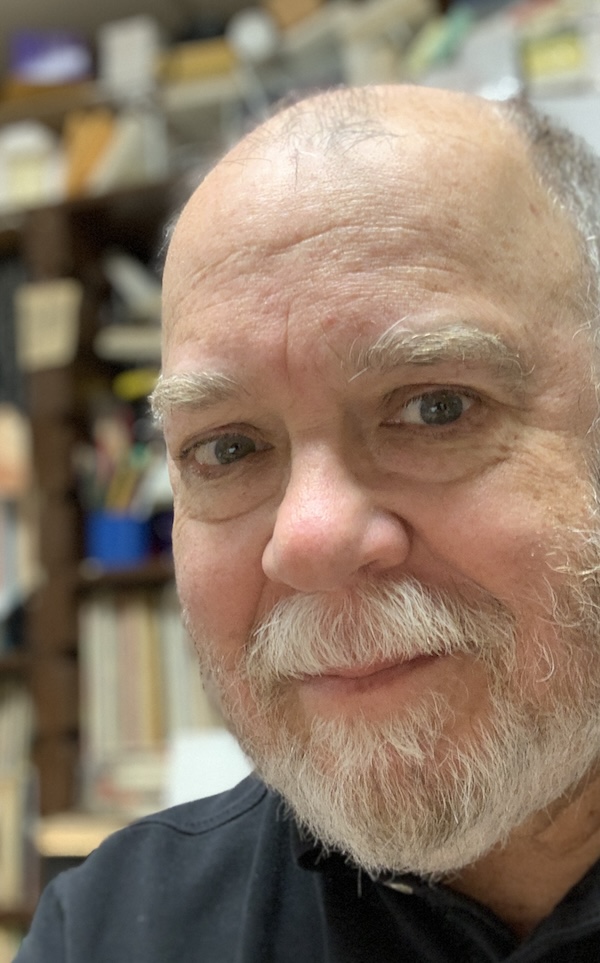
In the most recent installment of Letters from an American , Heather Cox Richardson contrasts yesterday’s speeches, one by the current occupant, one by King Charles III. “They presented,” she says, “a very clear picture of what is at stake in the United States today.”
Thursday, April 30, 2026

Wednesday, April 29, 2026
86
The slang term 86 , or eighty-six, has many meanings and can function as an adjective, a verb, or an exclamation (Green’s Dictionary of Slang ). The claim that “a reasonable recipient who is familiar with the circumstances would interpret [the numbers 86 47] as a serious expression of an intent to do harm” is beyond ludicrous.
[Why was bumbling Maxwell Smart of Get Smart Agent 86? It was a joke: to eighty-six someone is to throw them out — of a bar, restaurant, &c. Tom Waits: “I’ve been eighty-sixed from your scheme” (“Nighthawks at the Diner”). Jonathon Green‘s first citation for the murderous meaning is from 1978.]
On Duke Ellington’s birthday
Edward Kennedy Ellington was born 127 years ago today.
It’s a good day to watch or rewatch On the Road with Duke Ellington (dir. Robert Drew), an hour-long Bell Telephone Hour episode that aired in 1967 and again, with a brief prologue, after Ellington’s death in 1974. Among the highlights: Ellington talking with Louis Armstrong (9:25), calling room service to ask after his hot water (12:52), leading the band in a recording studio (22:20), playing his first composition, “Soda Fountain Rag” (29:46), and talking about Billy Strayhorn (40:20).
It astonishes me to realize that Duke Ellington’s music has been improving my quality of life for more than fifty years.
Related reading
All OCA Duke Ellington posts (Pinboard)
The white stripe
We were out and about in the car on Monday and found ourselves caught in a rainstorm that brought the worst visibility I have ever — wait for it — seen. On the highway, with no place to pull over safely, I slowed down, put on the hazard lights, and navigated by following the white stripe between our lane and the shoulder. That was literally all I could see to make sense of things. When we were able to exit, we did, and we got to a McDonald’s right before the doors were locked. Why? A tornado warning, and there was just enough room for everyone in the building to shelter in the bathrooms if necessary. (It wasn’t.)
I think it’s good advice to share: when in doubt, follow the white stripe. It’s also helpful in thick fog and when an oncoming driver has insanely bright headlights. Follow the white stripe.
A related post
Turn on your hazard lights
[Post title with apologies to Jack or Meg.]
Tuesday, April 28, 2026
Redact, redact
The State Department is close to finalizing a radical redesign of the U.S. passport to include a picture of President Donald Trump, The Bulwark has learned from two sources with knowledge of the redesign, including one who shared images currently under consideration.I would suggest a revision:

As you can see from my redactions, they haven’t even bothered to center his name.
[This post is, of course, an effort in redaction and not a threat to harm.]
Against gamification
In The New York Times (gift link), Molly Worthen, a professor of history, writes against the gamification of education:
No technology is philosophically neutral. The apps and games that provide a simulacrum of educational progress also encourage students to absorb a certain worldview, an idea of what they should strive for. They end up with the impression that learning is a matter of box ticking, pattern recognition, completing discrete tasks and “leveling up.”Thanks, Ben!
When they get to college and face open-ended essay questions and other forms of ambiguity — when they begin thinking about what they should do after graduation and try to figure out the point of it all — they panic. When a professor asks them to read an entire novel, the task feels overwhelming.
They got into college by mastering a gamified system. But that’s a false picture of the world. Take it from Emerson. He wrote in “Self-Reliance” that real education requires a person to learn that there is no algorithm for fulfillment: “Though the wide universe is full of good, no kernel of nourishing corn can come to him but through his toil.” Serious intellectual work and moral reasoning cannot be gamified.
Three related posts
Annals of pedagogy (With Hospital Spelling and Punctuation Football) : On “meeting them where they are” : Parts and wholes
Twelve movies
[One to four stars. Four sentences each. No spoilers. Sources: Amazon Prime, Netflix, TCM, YouTube.]
Crazy, Stupid, Love (dir. Glenn Ficarra and John Recqua, 2011). Ovid would understand the premise: eros makes people do all sorts of things. The cast full of famous names — Steve Carell, Ryan Gosling, Julianne Moore, Emma Stone, Marisa Tomei — but nothing here amounts to very much. And plot elements that seem highly dubious in 2026 were just as dubious in 2011. A shark moves through the waters from early on, but wait for the mini-golf. ★★ (N)
*
Loose Ankles (dir. Ted Wilde, 1930). Ann, an heiress (Loretta Young, then seventeen at the most), is set to inherit a fortune, so long as she avoids scandal and marries someone of whom her priggish aunts approve. Ann isn’t having it and gets a man (Douglas Fairbanks Jr.) with whom to create a scandal. Mayhem follows. Best moments: the drunken aunts in the company of two gigolos in the Circus Café. ★★★ (YT)
*
[Here’s “Loose Ankles”, by Andy Kirk and His Twelve Clouds of Joy. Arrangement by Mary Lou Williams.]
*
The Irishman (dir. Martin Scorsese, 2019). I had avoided this movie because of its length (three and a half hours) and the use of CGI to deage the actors, but I gave in, and am happy to have done so. The real Frank Sheeran (Robert De Niro), who is here a Zelig-like presence in one crime scenario after another, was likely a bit player who created a grandiose past for himself, but that past makes for a compelling story. Funny and chilling, and the violence is blessedly brief. With Joe Pesci as a minor mob boss and Al Pacino as a hilariously unhinged Jimmy Hoffa. ★★★★ (N)
*
Louis Theroux: Inside the Manosphere (dir. Adrian Choa, 2026). Exactly what it sounds like: interviews with prominent influencers in the so-called manosphere. Their female partners are either silent or seemingly complicit; their male followers (one of whom spent time living in his car) appear sadly deluded about their own prospects for success. Theroux: “It struck me that the matrix [the influencers] rail against more accurately describes the algorithmic prison they’ve created for their followers, an illusion of wealth and power that actually only enriches a few at the top.” So many deluded men and women on display here. ★★★★ (N)
*
The Devil’s Mask (dir. Henry Levin, 1946). When I realized that we were watching a film in the I Love a Mystery series, I knew that we were in for a waste of time. The plot, concerning shrunken heads and a missing or murdered explorer/scientist, is preposterous, with nearly every character a suspect. Beautiful compositions in light and dark, reminiscent of Cat People, provide some redeeming value (the cinematographer here, Henry Freulich, is unknown to me). As a fan from childhood of Clifford Hicks’s Alvin’s Secret Code, I did like seeing a scytale carry the day. ★★ (YT)
*
Mr. Nobody Against Putin (dir. David Borenstein and Pavel Talankin, 2025). In the grim industrial town of Karabash (UNESCO calls it the most toxic place on earth), Pavel “Pasha” Talankin, videographer and events coordinator for a primary school, begins to document the transformation of curriculum and school culture as the “special military operation” against Ukraine takes shape. Teachers and students read from government-prepared scripts as Talankin documents it all for the regime and, sometimes, asks for retakes (a teacher stumbles over the Russian for “demilitarization,” and Talankin advises her to skip it and just say “denazification”). Most chilling scenes: the history teacher who speaks of his admiration for Stalin’s henchmen, and the Wagner mercenaries doing a presentation for the children about mines and weapons, followed by marching and shooting practice and grenade-throwing contests, all as former students are dying in Ukraine. Talankin is now somewhere in Europe, and the footage he was able to take out of Russia speaks an urgent message to those of us who wonder what one person might do in the face of fascism. ★★★★ (A)
*
The Booksellers (dir. D.W. Young, 2019). A documentary about the world of buying, selling, and collecting rare books. I realized at some point that the movie is structured like a bookstore: you just move from one topic (one shelf or one book) to another, but the randomness is hardly a problem; rather, it offers the joy of browsing. But there’s relatively little here about the joy of reading. One problem with watching this movie on Amazon Prime: you can’t hit Pause to the read the titles on spines without an advertisement taking over the screen (thanks, Jeff). ★★★ (A)
*
Erin Brockovich (dir. Steven Soderbergh, 2000). Nevertheless, she persisted. The title character (Julia Roberts), an unemployed woman with three children and considerable grit, talks her way into a clerical position at a law firm and ends up the prime mover in a multi-family multimillion-dollar case against rampant polluter Pacific Gas and Electric Company. The most interesting scenes are those that show American class distinctions at work: Erin facing down dowdy coworkers and a power-suited PG&E lawyer, Erin’s boss (Albert Finney) agreeing to stay around and have coffee and cake with a family that’s signed on to the complaint. The story is so inspiring that I can’t imagine anyone new to it taking it as fiction: it’s too good not to be true. ★★★★ (N)
*
Up the Down Staircase (dir. Robert Mulligan, 1967). We were reading A Tale of Two Cities, so we wanted to watch the scene in which Miss Barrett’s class engages in vigorous discussion of the best of times, the worst of times. And we ended up watching the whole movie again. Sandy Dennis shines as a rookie teacher who persists. Three of the teenagers who add a lot to the movie (and went on to appear in virtually nothing else): Lew Wallach (Lew), Ellen O’Mara (Alice), and Jose Rodriguez (Jose). ★★★★ (TCM)
[More sentences, from 2018, 2020, and 2023.]
*
The Others (dir. Alejandro Amenábar, 2001). Post-WWII, Grace (Nicole Kidman), whose husband went off to war, lives in a dark mansion on the island of Jersey with her two young photosensitive children and a newly arrived trio of housekeeper, mute maid, and gardener. One might say that there’s a ghost story just waiting to happen here. And there is, with strong overtones of The Turn of the Screw. But this story veers off in a different, even scarier direction. ★★★★ (CC)
*
We Were Strangers (dir. John Huston, 1949). Cuba, 1933, as a band of revolutionaries led by Tony Fenner (John Garfield) labor on an extravagant plot to bring down the regime of the dictator Gerardo Machado. The movie is short on suspense and long on scenes of conversation among the dirty, sweaty revolutionaries (whose plot requires the digging of a long tunnel). And there’s little chemistry between Garfield and Jennifer Jones, who plays the sister of a slain revolutionary. One unexpected element: an opportunity to see Ramon Novarro late in his career. ★★ (YT)
*
Street Girl (dir. Wesley Ruggles, 1929). A sweet pre-Code story, with homeless immigrant violinist Freddie Joyzelle (Betty Compson) finding a home with and doing housekeeping for The Four Seasons, a jazz band (Elaine immediately caught the Snow White connection). With Freddie’s help the band lands a gig in the swankiest restaurant in town. Compson is a fine comic actor and capable musician (though her playing here is dubbed); Jack Oakie (Joe Spring) and Ned Sparks (Happy Winter) are the faces I recognize among the Seasons. There’s considerable joy in the musical performances (see Jack Oakie dance!), with tunes credited to Oscar Levant and Sidney Clare, and there’s even a prince to complicate Freddie’s growing romance with Season Mike Fall (John Harron). ★★★★ (TCM)
Related reading
All OCA “twelve movies” posts (Pinboard)
Recently updated
Laundry &c.: An assiduous reader discovered that 60 Eldridge Street, the building with a shabby something-stand in front, was the birthplace of a great American lyricist.
Monday, April 27, 2026
Pulp Faulkner (4)

 [William Faulkner, Mosquitoes (1927). New York: Avon, n.d. Click either image for a larger view.]
The strangest of my four pulp Faulkners. So strange that it lacks both a publication date (sellers at Advanced Book Exchange say 1941) and a cover price, though the inside back cover establishes that volumes in the New Avon Books series sold for 25¢. I no longer have any idea how I acquired this book.
Have I read Mosquitoes ? No, my interest in Faulkner is restricted to Yoknapatawpha County. I once supervised an independent study in Faulkner that was Yoknapatawpha-centric — which was more than enough for fifteen weeks. No Mosquitoes. No Pylon. The omission of Pylon horrified a fellow academic. Seriously? What should I have left out to make it fit? [Shakes head .]
Related posts
Dickens, 45¢ : Pulp Faulkner (1) : Pulp Faulkner (2) : Pulp Faulkner (3) : Pulp Hammett
Pulp Faulkner (3)

 [William Faulkner, The Wild Palms and The Old Man (1939). New York: New American Library, 1954.]
It’s one novel, really, first published as The Wild Palms, later published with Faulkner’s chosen title, If I Forget Thee, Jerusalem added. This paperback splits the alternating chapters of the novel’s separate narratives into two shorter novels. Such is the fate of a modernist writer in paperback.
I’ve not read The Wild Palms. My interest in Faulkner is limited to Yoknapatawpha County.
If you look at the bottom right corner, you’ll see the signature of James Avanti.
Related posts
Dickens, 45¢ : Pulp Faulkner (1) : Pulp Faulkner (2) : Pulp Faulkner (4) : Pulp Hammett
Subscribe to:
Posts (Atom)